
Buildings
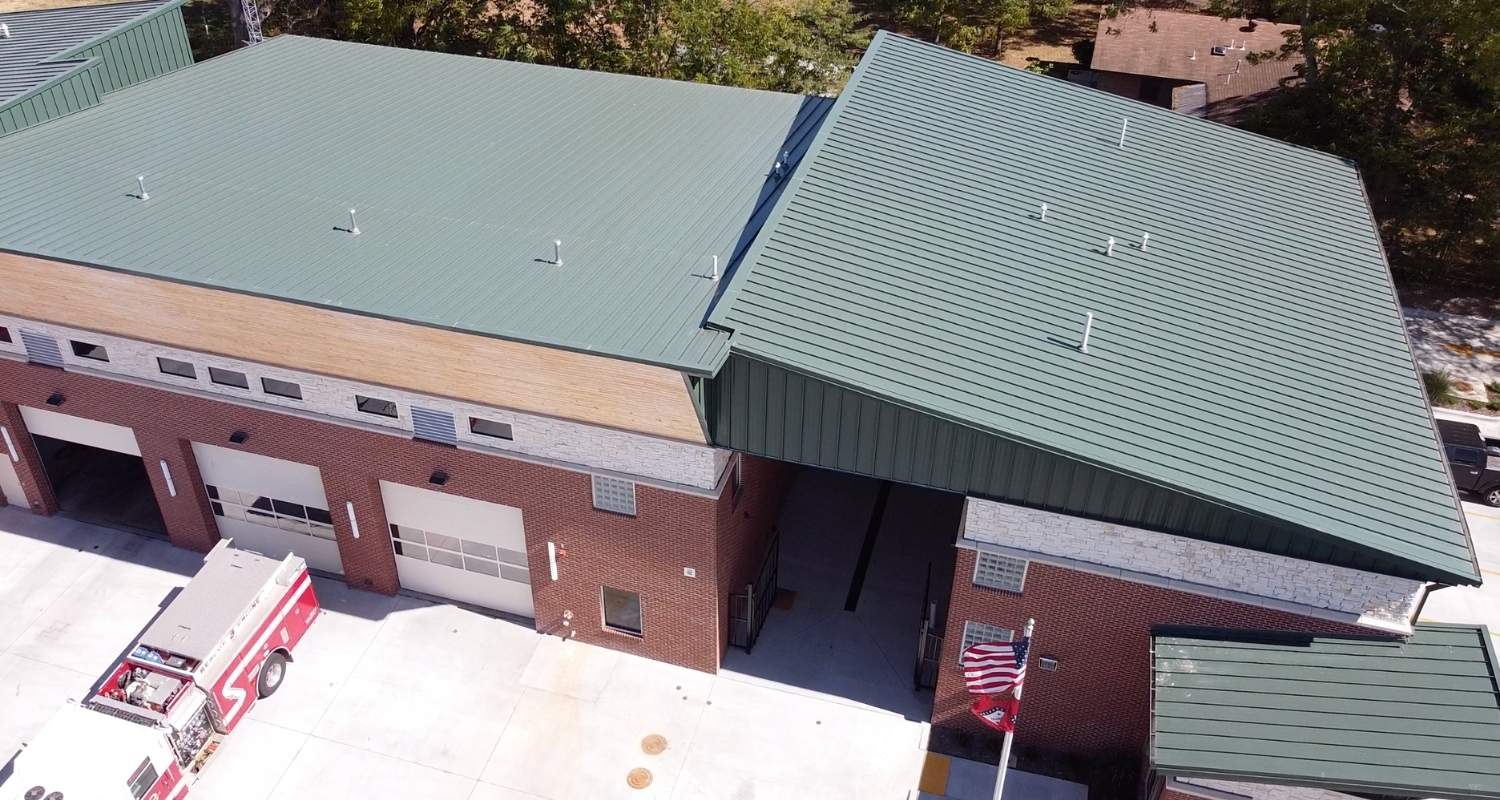
Fire Station & Emergency Services Facility Roofing in Charleston, SC.
Charleston's commercial corridors stretch along the I-26 and I-526 industrial ring, the Ashley Phosphate Road commercial belt, and the rapidly expanding Summerville and Goose Creek.
Request Roof WalkFire Station
& Emergency Services Facility Roofing
Roof Scope Notes
Charleston's commercial corridors stretch along the I-26 and I-526 industrial ring, the Ashley Phosphate Road commercial belt, and the rapidly expanding Summerville and Goose Creek suburban employment zones. Fire stations in this market are public facilities that require roofing contractors who can work around continuous emergency response operations - apparatus bay access, daily alarm protocols, and apparatus exhaust exposure conditions that affect product selection are all standard pre-conditions for fire station roofing in this jurisdiction.
For Government and Municipal Roofing, Charleston County Economic Development identifies logistics, aerospace, tech and innovation, automotive, tourism and hospitality, life sciences, and military and defense as county industry targets.
The apparatus bay roof is the most technically demanding section of a fire station re-roofing project in Charleston. Large overhead door openings - typically 14-16 feet tall and 12-14 feet wide per bay - create a structural transition at the bay wall that generates significant thermal movement. The bay interior is heated primarily by diesel engine exhaust from apparatus operations, and the repeated thermal cycling from apparatus return and warm-up creates a temperature differential at the bay-to-mezzanine roof transition that exceeds what standard commercial flashing details can accommodate over a 20-year service life. We design the bay transition as an expansion joint, not a standard flashing transition.
Diesel exhaust exposure is a consideration in the apparatus bay roof assembly specification. The underside of the bay roof deck is exposed to diesel combustion products from apparatus start-up and in-bay warm-up operations. Over time, diesel particulate and combustion condensate can degrade certain adhesive formulations and vapor retarder materials. We specify products for the apparatus bay assembly that are rated for exhaust-adjacent environments - not products that are appropriate for a clean-air commercial occupancy but will degrade under diesel exposure.
Historic firehouses in Charleston - the older stations that have served their neighborhoods for generations - frequently carry architectural roofing systems: slate, clay tile, standing seam copper or terne metal. These materials age on a different timeline from modern commercial roofing systems, and their restoration or replacement requires contractors who understand both the historical material and the Secretary of the Interior's Standards for Rehabilitation that apply to designated landmark buildings. We've worked with preservation architects on historic firehouse roofing projects and have experience sourcing historically compatible materials for buildings where original materials are no longer manufactured.
The bay-to-mezzanine transition joint is treated as a structural expansion joint with a joint seal system rated for the calculated movement range at that transition. The movement range is calculated from the bay width - the thermal movement of a 60-foot steel bay roof frame is significantly larger than the movement of a 20-foot office module frame - and from the temperature differential between the diesel-heated bay interior and the ambient exterior. We use a two-part joint cover system - a membrane base with a foam core and a metal cap - that accommodates the calculated movement without fatiguing the membrane bond.
The apparatus bay roof specification must account for the diesel exhaust exposure from below and the thermal movement at the bay transitions. For flat-to-low-slope apparatus bay roofs in Charleston, a 60-mil or 80-mil mechanically attached TPO system is the appropriate specification - TPO has good resistance to diesel exhaust condensate compared to EPDM, and mechanically attached systems tolerate the long-span deck movement better than fully adhered systems. The bay roof should be considered a separate specification zone from the administrative/crew areas of the station.
Questions Building Owners Ask
Related Roof Planning
Big-Box Retail Roofing
A roof problem above building owners and operations teams can stall a Lowcountry building before anyone has a clean scope, so we treat Big-Box Retail Roofing as field work before product.
Government and Municipal Roofing
We start Government and Municipal Roofing work with the roof record, leak history, access point, and the people who will be disrupted if the job is handled casually. On a government and.
Senior Living Facility Roofing
For Warehouse Roofing, SC Ports states that one in nine South Carolina jobs is connected to the port and that SC Ports owns and operates the Port of Charleston. That Charleston Warehouse.
Food Processing Facility Roofing
A food plant roof works two jobs at once that pull in opposite directions: it has to hold back a humid Lowcountry sky from above while managing the washdown moisture and refrigeration.
Daycare & Childcare Facility Roofing
Charleston's commercial corridors stretch along the I-26 and I-526 industrial ring, the Ashley Phosphate Road commercial belt, and the rapidly expanding Summerville and Goose Creek.
Restaurant and Food Service Building Roofing
Charleston's food service scene is one of the most celebrated in the American South, driven by the renowned dining corridor along East Bay Street and the lower King Street restaurant.
Contact Us
Plan
With
Us.
Send the roof address, access notes, roof age if known, leak photos, and any operating limits below the roof. We will map the first roof walk around the building, weather window, and urgency of the issue.
Get In Touch