
Roof Work
Humidity & Moisture Damage Roof Repair in Charleston, SC.
Not every wet roof in the Lowcountry leaked. A large share of the moisture problems we open up on Charleston commercial buildings never came through the membrane at all; the water was.
Request Roof WalkHumidity &
Moisture Damage Roof Repair
Roof Scope Notes
Not every wet roof in the Lowcountry leaked. A large share of the moisture problems we open up on Charleston commercial buildings never came through the membrane at all; the water was generated inside and pushed up into the assembly by the same coastal humidity that defines the region. A laundry running steam off Rivers Avenue, a food plant near the Charleston Trade Center, a self-storage building off Ashley Phosphate Road with no real ventilation, a restaurant kitchen on the peninsula running exhaust hoods all day. Each of those puts a constant load of warm, wet air against the underside of the deck, and when the vapor management is wrong, that air condenses inside the insulation and stays there. This page is about that failure mode specifically, and why it gets misdiagnosed as a leak more often than any other roof problem we see.
Charleston spends most of the year warm and saturated, with summer dew points that sit in the seventies for weeks at a time. Inside a conditioned building, the air is cooler and drier than the outdoor air for part of the year and warmer and wetter than the deck for another part, so vapor drive here reverses with the seasons rather than pushing steadily one direction the way it does in a cold climate. That matters because a vapor retarder placed for a heating climate, above the insulation, can trap moisture against the deck during our long cooling season instead of keeping it out. When the building's interior humidity has nowhere to escape and the retarder is fighting the dominant drive, the dew point lands inside the insulation layer and water collects where no one can see it.
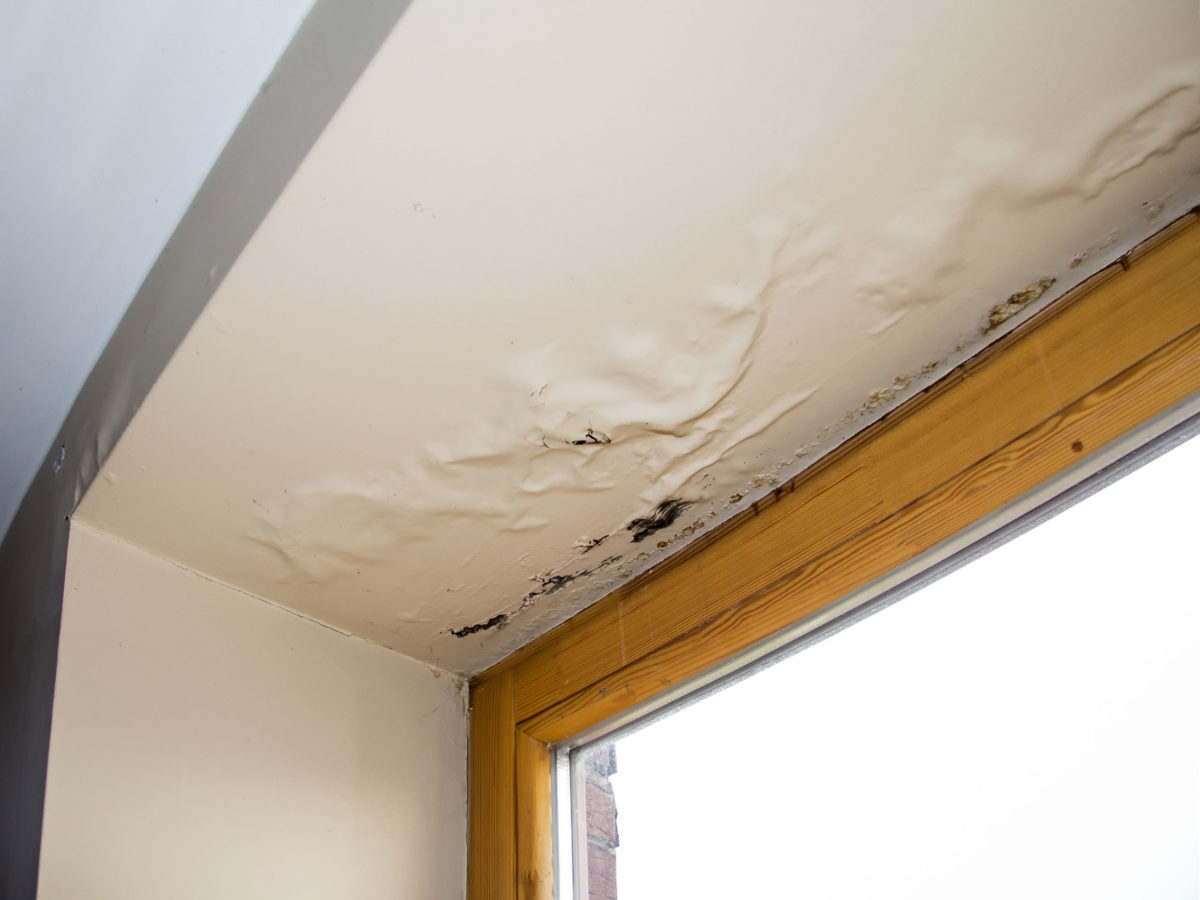
The tell is that the damage does not track rainfall. An owner reports staining and soft spots that appear in stretches of dry weather, or worst right after a humid spell rather than after a storm. That pattern is the signature of interior-sourced moisture, and chasing it as a membrane leak wastes money sealing a roof that was never the entry point.
When moisture trapped between the membrane and substrate heats up under the Carolina sun, it turns to vapor and expands, lifting the sheet into raised blisters. On a single-ply roof these show as domes that flex underfoot; on a built-up roof they are interply blisters that grow each summer. A blister is not just cosmetic. It is delaminated membrane that has lost its bond, and it is a thin spot waiting for the next hailstone or dropped tool to open it.
On older built-up and modified roofs, trapped moisture wicks into the felts and the insulation joints, then expands and contracts until the membrane buckles into long ridges that run the lines of the insulation boards below. Ridging tells us the moisture has been resident long enough to move through the assembly, not a fresh intrusion.
The real damage is in the insulation. Wet polyiso or fiber loses most of its R-value, so the building bleeds conditioned air and the HVAC runs harder to hold setpoint, which in a humid climate also means it is dehumidifying harder and feeding more moisture back into the cycle. Worse, insulation sitting wet against a steel deck drives corrosion, and a deck that has carried saturated board across two or three roof cycles can be perforated through from below while the topside still looks intact.
We start with an infrared moisture survey, flown or walked after sunset when the contrast is sharpest. Wet insulation holds the day's heat longer than the dry field around it and glows warmer in thermal, which maps the saturated zones as discrete shapes. Infrared shows us where the water is, but not how much or what it has done, so we confirm the flagged areas with core cuts. A core tells us the depth of wet insulation, the condition of the vapor retarder and where it sits in the stack, and whether the deck underneath has begun to rust. Only with the cores in hand do we know whether this is interior humidity, a failed retarder, or a genuine leak, and the correct repair is different for each.
Questions Building Owners Ask
Related Roof Planning
Manufacturing Facility Roofing
Volvo Cars' manufacturing plant in Berkeley County, South Carolina - the Swedish automaker's only North American production facility - represents the leading edge of advanced manufacturing.
Restaurant and Food Service Building Roofing
Charleston's food service scene is one of the most celebrated in the American South, driven by the renowned dining corridor along East Bay Street and the lower King Street restaurant.
EPDM Commercial Roofing
The first useful note for EPDM Commercial Roofing is written at the roof hatch, after we see drainage, traffic, equipment, and how the building is used. On a EPDM commercial roofing call,.
Roof Tear-Off and Replacement
A Charleston buyer searching for Roof Tear-Off and Replacement usually needs an answer that can survive budget review, not a vague promise. On a roof tear-off and replacement call, we ask.
Skylight and Penetration Flashing
The first useful note for Skylight and Penetration Flashing is written at the roof hatch, after we see drainage, traffic, equipment, and how the building is used. On a skylight and.
Self-Storage Facility Roofing
Charleston, South Carolina's self-storage market has grown steadily alongside the region's population boom, and operators like CubeSmart on Rivers Avenue know that the coastal climate.
Contact Us
Plan
With
Us.
Send the roof address, access notes, roof age if known, leak photos, and any operating limits below the roof. We will map the first roof walk around the building, weather window, and urgency of the issue.
Get In Touch